• Skip to main content
  • Skip to secondary menu
  • Skip to primary sidebar

Gaynor Marshall | Sewing and Design

Designing Calm, One Stitch at a Time

  • Home
  • Store
  • About
    • Copyright
    • Disclosure Policy
  • Blog
    • The Cottagecore Aesthetic: Understanding What it is and How to Use it
    • Crafting for Wellness
      • Mindful Crafting: Unlock Creativity and Transform Wellbeing
    • Discover the Inventor of the Sewing Machine: A Fascinating History
    • Sewing
      • Spring Sewing Delights: Fresh Projects to Celebrate the Season
      • Sewing Essentials: Setup & Success
        • How to Set Up an Inspiring Sewing Workspace at Home
        • Sewing Tools: My Essential Top Ten
        • Stitch Library – Ultimate Guide
        • Successful Sewing: My 5 Secrets
        • Thread Basics: The Ultimate Beginner’s Guide to Sewing and Embroidery
    • Tutorials
      • Buttons: Make Your Own
      • Creative Ways to Use Machine Embroidery for Stunning Projects
      • Drawstring Bags: Make Your Own
      • Creative Embroidery Templates: Think Outside the Box for Unique Designs
      • Mini Bunting Make Your Own
      • Take Your Sewing to the Next Level
      • Zips
        • Zips, Part 1: Invisible Zip
        • Zips, Part 2: Semi-concealed Zip
        • Zips, Part 3: Concealed Zip
        • Zips, Part 4: Exposed Zip
  • Get In Touch
    • Cookie Policy
    • Privacy Policy
    • Terms & Conditions
Home » Blog

Blog

Wonkyverse – a new way to look at creativity!

May 25, 2024 By Gaynor Marshall

Welcome to the Wonkyverse, where creativity meets sustainability in the vibrant world of original hand-drawn illustrations! Here, every piece of art tells a story, blending whimsy and playfulness with a deep commitment to the planet.

Our passion shines through

At Wonkyverse, our passion for art shines through in every unique creation. We embrace a style that’s wonky, quirky, and full of personality. From the intricate details to the vibrant colors, each piece is a testament to our dedication to handmade artistry.

We make the planet happy too

Our commitment to the planet is just as strong as our love for art. We believe that beautiful things should not come at the expense of the environment. That’s why we’ve partnered with sustainable print-on-demand supplier Teemill. This collaboration ensures that all our products are made using sustainable methods, including renewable energy and eco-friendly inks. To top it off, everything is completely plastic-free. We believe in taking care of the Earth as much as we do in creating beautiful things.

Our sustainable approach doesn’t stop at production. Every step of our process is designed with the environment in mind. From the materials we choose to the packaging we use, sustainability is at the core of everything we do. This means you can shop with confidence, knowing that your purchase supports eco-friendly practices and contributes to a healthier planet.

Something for everyone

Whether you’re shopping for a special gift or looking to brighten up your own space with a touch of whimsy, Wonkyverse has something for everyone. Our collections include a variety of prints that can transform any room, greeting cards that make every message special, and gifts that are perfect for any occasion. Each item is a little piece of art, designed to spread joy and bring a bit of magic into everyday life.

Join us in celebrating creativity, sustainability, and the joy of handmade artistry. The Wonkyverse is more than just a brand; it’s a community of like-minded individuals who value originality, quirkiness, and a sustainable lifestyle. By choosing Wonkyverse, you’re not just buying a product; you’re supporting a movement towards a more creative and eco-conscious world.

So, come and explore the Wonkyverse! Let our unique designs inspire you and add a splash of whimsy to your life. Together, we can make a difference—one beautifully crafted, sustainably made piece of art at a time.

Stay In Touch

Keep up to date with all our latest store news direct to your inbox. Subscribe now.

Thank you!

You have successfully joined our subscriber list.

facebookShare on Facebook
TwitterTweet
FollowFollow us
PinterestSave

Hand drawn lettering and a new store

April 10, 2024 By Gaynor Marshall

The new Wonkyverse store is now open for business. My new products, showcase my hand drawn lettering. Currently I have a selection of art prints, greeting cards, mugs and tea towels for purchase. (My new product range is available here.)

Inspiration and a feeling of coming home

A very boring lesson on graphic design at art college put me off hand lettering for life. That lesson alone, made lettering something that I always avoided.

After studying contemporary hand lettering through more mature eyes, I have become aware of its’ beauty as an art form in itself.

Research

I began looking for hand lettering wherever I could find it. As I wanted to understand the reasons behind the various design choices that make up the lettered forms I knew I needed outside guidance.

Amazingly, renowned illustrator Lilla Rogers, announced she had created a new course. Incredibly, it was going to be all about the beauty and artistry of the hand lettered form. How serendipitous was that?

I signed up immediately.

Going to back school

The three month Lettering Bootcamp has been amazing. After my previous reluctance to explore the subject of hand lettering, I was surprised to discover that I love it.

After making the decision to use traditional media for the majority of the course. I have been loving getting my hands dirty.

I completed each assignment in Procreate. This was purely because it was easier to manipulate the file for uploading to the gallery.

Some of the daily mini assignments were tricky to copy. I persevered though and discovered what I did and didn’t like to draw and incorporate into my own emerging style.

Assignment 1 – chocolate bar
Assignment 2 – book cover

As I write this, I am about to start working on the third and final assignment. And I am quite sad that it is drawing to a close. Although, my new found love for hand lettering and my new store will definitely keep me busy.

Until next time…

facebookShare on Facebook
TwitterTweet
FollowFollow us
PinterestSave

The Elephant: majestic, beautiful and precious

April 28, 2023 By Gaynor Marshall

The elephant is the largest land animal on Earth.

There are actually three distinct species of elephant. Two genetically different species of African elephants. The savanna elephant (Loxodonata Africana) and the African forest elephant (Loxodonata Cyclotis). And the Asian forest elephant (Elephas Maximus Indicus).

All elephants have trunks.

These trunks are used for lots of different things:

  • to greet other elephants; to make sounds
  • to breathe; to draw up water for drinking and bathing
  • and to pick up food.

Mastering the use of trunks takes practice.

It may surprise you to know that elephants have very sensitive skin. They take regular mud and dust baths to protect themselves from sunburn, insect bites and moisture loss.

Celebrating elephant differences

The African savanna elephant is the largest elephant species. Males can stand between 8 – 13 feet at shoulder height and weigh up to 7 tonnes.

The largest African elephant ever recorded was found in Angola. The impressive specimen weighed in at a mighty 24,000 pounds which is almost 11 tonnes and he had a shoulder height of 13 feet!

The African forest and the Asian forest elephant are somewhat smaller in size. They can stand between 6.6 – 11.5 feet at the shoulder, and can weigh up to 4 tonnes.

All elephants are herbivores and eat mainly grass, leaves, twigs, buds, fruit, roots and bark.

Asian elephants differ in a number of different ways from their African cousins.

Only male Asian elephants can have tusks.

Male and female African elephants can have them.

Asian elephants have smaller ears.

African elephants can live for around 70 years in the wild. Asian elephants have an average lifespan of around 48 years.

Family groups

Elephants live in family groups called herds. The herd is made up of females and calves.

Male elephants, tend to live solitary lives or stay together in small bachelor groups. Females give birth after a 22 month pregnancy, and usually have a single baby. Elephant calves are watched over by the entire herd of related females who relish the role of babysitter. Females may stay with their herd for their entire lives. Males usually leave as they reach puberty.

Forest elephant herds may simply comprise of a mother and her offspring. Sometimes they do gather in larger groups in forest clearings.

Tusks

African elephants can be right or left tusked. The favoured side is usually shorter.

Tusks are actually teeth. They serve lots of purposes:

  • to protect the elephant’s trunk
  • to gather food
  • as a rest for their trunk
  • to lift and move objects
  • and even strip bark from trees
  • for defence
  • and to dig holes to find water underground

The most important thing to remember is that only ELEPHANTS need tusks and that we should do everything we can to stop the illegal ivory trade.

The poaching of elephant tusks has far reaching consequences, way beyond the loss of the individual.

The killing of mothers leaves calves orphaned and exceptionally vulnerable. Without the experience and knowledge of older females herds may be unable to survive. That knowledge is lost and gone forever.

If older bulls with huge tusks are murdered, these animals can no longer pass on the genes necessary to produce large tusks in future generations.

Everything is connected.

Elephants as a keystone species

African elephant populations have decreased at an alarming rate. A hundred years ago, it is estimated that there were 12 million individuals. That figure today has been reduced to around 400,000.

Elephants are a keystone species, meaning they play a vital role in maintaining a healthy eco-system.

Did you know an elephant footprint, when filled with water, can provide a home for tadpoles and other organisms?

Elephants need large areas of land to be able to survive and meet their need for food, water and space.

They can feed for up to 18 hours a day. This requires access to large amounts of food which can bring them in to conflict with expanding human populations.

Agricultural development and the building of roads, canals, fences and houses means less space for elephants.

We need to:

  • consider the impact of our increasing global population on the natural world.
  • take steps to protect ancient migratory routes, to reduce human-wildlife conflict
  • educate people to make sure they understand how we humans affect wildlife

Banning the international commercial trade in elephant ivory is only one half of the story. Enforcement is key to its success.

Education, enforcement and protection.

How you can help

Please show your support in any way that you can. Spread the word to family and friends or donate directly to the organisations that are working hard to protect our wildlife.

We simply cannot lose them.

https://www.sheldrickwildlifetrust.org 

Further reading

https://gaynormarshalldesigns.com/who-smells-like-popcorn

https://gaynormarshalldesigns.com/the-western-lowland-gorilla-save-them-now

facebookShare on Facebook
TwitterTweet
FollowFollow us
PinterestSave

Who Smells Like Popcorn? Fun facts about the Binturong

March 8, 2023 By Gaynor Marshall

  • The Binturong is a mammal.
  • One of the most unusual features of the binturong is its scent. It smells like a freshly made batch of popcorn!
  • It has a face like a cat and a body like a bear which is why they are also known as bearcats.
  • Their scientific name is: Arctictis Binturong.
  • Binturongs are classed as carnivores but will eat most things.
  • They are born after 84-92 days gestation, their eyes are still sealed and they remain hidden in their mothers’ thick fur for the first few days of life.
  • Binturongs live solitary lives apart from females with offspring who tend to live in family groups.
  • They have a lifespan of between 15.6 years for females and 18.8 years for males.
  • Binturongs are related to civets and fossas and spend most of their time in the trees. They do however tend to climb down to get from tree to tree as they are not very agile.
  • They can turn their ankles 180 degrees in order to grip the tree trunk when climbing down head first.
  • The end of the binturong’s tail is actually prehensile, meaning it can use it like an extra hand when climbing. A leathery patch at the tip also helps them to grip.
  • The binturong is the only mammal to be found in Africa, Asia and Europe and only one of two carnivores with a prehensile tail (the other is a kinkajou).
  • In some parts of their range they are listed as vulnerable, in other parts endangered.
  • Binturongs are at risk from: habitat destruction; poaching for use in traditional Asian medicine; the fur and pet trade; and in some areas they are considered a delicacy and hunted for food.

How you can help

Please show your support in any way that you can; spread the word to family and friends; donate directly to the wildlife organisations that are working every day to protect these majestic animals.

We simply cannot lose them. 

facebookShare on Facebook
TwitterTweet
FollowFollow us
PinterestSave

The Western Lowland Gorilla – Save Them Now

September 23, 2022 By Gaynor Marshall

The Western lowland gorilla is a great ape and is the most numerous and widespread of all gorilla subspecies.

The Western lowland gorilla can be found in the rainforests and swamps of Cameroon, the Central African Republic, the Democratic Republic of Congo and Equatorial Guinea and large areas of Gabon and the Republic of Congo.

Their scientific name is: Gorilla gorilla gorilla.

Western and Eastern Lowland Gorilla

There are two main species of gorilla; Western and Eastern.

The Western species are divided into the Western Lowland Gorilla and the Cross River Gorilla, which can be found in Cameroon and Nigeria.

The Eastern gorillas are divided into two further subspecies – the Eastern Lowland Gorilla (Grauer’s gorilla) and Mountain Gorillas.

Size and weight of the Western Lowland gorilla

Western lowland gorillas are slightly smaller than other gorilla subspecies and they have brown-grey fur and auburn chests and heads. They have wider skulls, a more pronounced brow and smaller ears.

Weight: up to 440 pounds.

Height: 4-5.5 feet.

Gorilla family dynamics

Gorilla groups are led by a dominant silverback who will defend his family to the death from any threat including that from humans.

Western lowland gorillas have the smallest family family groups of all gorillas consisting, on average, between 4-8 members.

Lifespan in the wild can be up to 40 years.

Gorillas are primarily herbivorous and they spend most of the day eating. They do take a break at midday when the adults take the opportunity for a nap and the youngsters play amongst themselves.

Western lowland gorillas show more tolerance towards non-relatives and gorillas from other groups and this appears to be unique to this particular subspecies.

Threats to their survival

Humans are the greatest threat to the survival of the Western lowland gorilla.

Human diseases such as influenza and ebola decimate family groups. Poaching, taking individuals for zoos and circus entertainment, medicine men who use gorilla body parts for charms, poisoning, habitat loss from illegal logging and mining all take their toll on populations.

Gorillas do not stand a chance without our help.

Status: critically endangered.

How you can help

Please show your support in any way that you can. It can be as simple as spreading the word to family and friends, or by donating directly to the wildlife organisations that are working every day to protect these majestic animals.

We simply cannot lose them. 

https://www.worldwildlife.org/species/western-lowland-gorilla

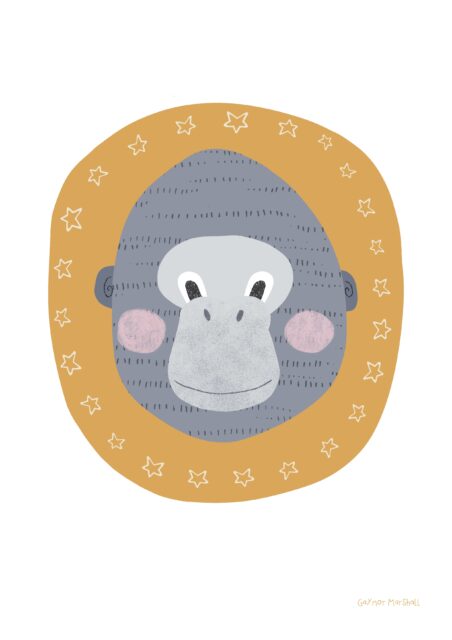
illustrated western lowland gorilla on a mustard background with a ring of hand drawn stars

https://gaynormarshalldesigns.com/the-elephant-majestic-beautiful-and-precious

https://gaynormarshalldesigns.com/who-smells-like-popcorn

facebookShare on Facebook
TwitterTweet
FollowFollow us
PinterestSave
« Previous Page
Next Page »

Primary Sidebar

Printable Downloads

Search

Join My Substack

Copyright © 2017-2026 Gaynor Marshall

We are using cookies to give you the best experience on our website.

You can find out more about which cookies we are using or switch them off in .

Gaynor Marshall | Sewing and Design
Powered by  GDPR Cookie Compliance
Privacy Overview

This website uses cookies so that we can provide you with the best user experience possible. Cookie information is stored in your browser and performs functions such as recognising you when you return to our website and helping our team to understand which sections of the website you find most interesting and useful.

Strictly Necessary Cookies

Strictly Necessary Cookie should be enabled at all times so that we can save your preferences for cookie settings.

Cookie Policy

More information about our Cookie Policy