• Skip to main content
  • Skip to secondary menu
  • Skip to primary sidebar

Gaynor Marshall | Sewing and Design

Designing Calm, One Stitch at a Time

  • Home
  • Store
  • About
    • Copyright
    • Disclosure Policy
  • Blog
    • The Cottagecore Aesthetic: Understanding What it is and How to Use it
    • Crafting for Wellness
      • Mindful Crafting: Unlock Creativity and Transform Wellbeing
    • Discover the Inventor of the Sewing Machine: A Fascinating History
    • Sewing
      • Spring Sewing Delights: Fresh Projects to Celebrate the Season
      • Sewing Essentials: Setup & Success
        • How to Set Up an Inspiring Sewing Workspace at Home
        • Sewing Tools: My Essential Top Ten
        • Stitch Library – Ultimate Guide
        • Successful Sewing: My 5 Secrets
        • Thread Basics: The Ultimate Beginner’s Guide to Sewing and Embroidery
    • Tutorials
      • Buttons: Make Your Own
      • Creative Ways to Use Machine Embroidery for Stunning Projects
      • Drawstring Bags: Make Your Own
      • Creative Embroidery Templates: Think Outside the Box for Unique Designs
      • Mini Bunting Make Your Own
      • Take Your Sewing to the Next Level
      • Zips
        • Zips, Part 1: Invisible Zip
        • Zips, Part 2: Semi-concealed Zip
        • Zips, Part 3: Concealed Zip
        • Zips, Part 4: Exposed Zip
  • Get In Touch
    • Cookie Policy
    • Privacy Policy
    • Terms & Conditions
Home » conservation

conservation

Who Smells Like Popcorn? Fun facts about the Binturong

March 8, 2023 By Gaynor Marshall

  • The Binturong is a mammal.
  • One of the most unusual features of the binturong is its scent. It smells like a freshly made batch of popcorn!
  • It has a face like a cat and a body like a bear which is why they are also known as bearcats.
  • Their scientific name is: Arctictis Binturong.
  • Binturongs are classed as carnivores but will eat most things.
  • They are born after 84-92 days gestation, their eyes are still sealed and they remain hidden in their mothers’ thick fur for the first few days of life.
  • Binturongs live solitary lives apart from females with offspring who tend to live in family groups.
  • They have a lifespan of between 15.6 years for females and 18.8 years for males.
  • Binturongs are related to civets and fossas and spend most of their time in the trees. They do however tend to climb down to get from tree to tree as they are not very agile.
  • They can turn their ankles 180 degrees in order to grip the tree trunk when climbing down head first.
  • The end of the binturong’s tail is actually prehensile, meaning it can use it like an extra hand when climbing. A leathery patch at the tip also helps them to grip.
  • The binturong is the only mammal to be found in Africa, Asia and Europe and only one of two carnivores with a prehensile tail (the other is a kinkajou).
  • In some parts of their range they are listed as vulnerable, in other parts endangered.
  • Binturongs are at risk from: habitat destruction; poaching for use in traditional Asian medicine; the fur and pet trade; and in some areas they are considered a delicacy and hunted for food.

How you can help

Please show your support in any way that you can; spread the word to family and friends; donate directly to the wildlife organisations that are working every day to protect these majestic animals.

We simply cannot lose them. 

The Western Lowland Gorilla – Save Them Now

September 23, 2022 By Gaynor Marshall

The Western lowland gorilla is a great ape and is the most numerous and widespread of all gorilla subspecies.

The Western lowland gorilla can be found in the rainforests and swamps of Cameroon, the Central African Republic, the Democratic Republic of Congo and Equatorial Guinea and large areas of Gabon and the Republic of Congo.

Their scientific name is: Gorilla gorilla gorilla.

Western and Eastern Lowland Gorilla

There are two main species of gorilla; Western and Eastern.

The Western species are divided into the Western Lowland Gorilla and the Cross River Gorilla, which can be found in Cameroon and Nigeria.

The Eastern gorillas are divided into two further subspecies – the Eastern Lowland Gorilla (Grauer’s gorilla) and Mountain Gorillas.

Size and weight of the Western Lowland gorilla

Western lowland gorillas are slightly smaller than other gorilla subspecies and they have brown-grey fur and auburn chests and heads. They have wider skulls, a more pronounced brow and smaller ears.

Weight: up to 440 pounds.

Height: 4-5.5 feet.

Gorilla family dynamics

Gorilla groups are led by a dominant silverback who will defend his family to the death from any threat including that from humans.

Western lowland gorillas have the smallest family family groups of all gorillas consisting, on average, between 4-8 members.

Lifespan in the wild can be up to 40 years.

Gorillas are primarily herbivorous and they spend most of the day eating. They do take a break at midday when the adults take the opportunity for a nap and the youngsters play amongst themselves.

Western lowland gorillas show more tolerance towards non-relatives and gorillas from other groups and this appears to be unique to this particular subspecies.

Threats to their survival

Humans are the greatest threat to the survival of the Western lowland gorilla.

Human diseases such as influenza and ebola decimate family groups. Poaching, taking individuals for zoos and circus entertainment, medicine men who use gorilla body parts for charms, poisoning, habitat loss from illegal logging and mining all take their toll on populations.

Gorillas do not stand a chance without our help.

Status: critically endangered.

How you can help

Please show your support in any way that you can. It can be as simple as spreading the word to family and friends, or by donating directly to the wildlife organisations that are working every day to protect these majestic animals.

We simply cannot lose them. 

https://www.worldwildlife.org/species/western-lowland-gorilla

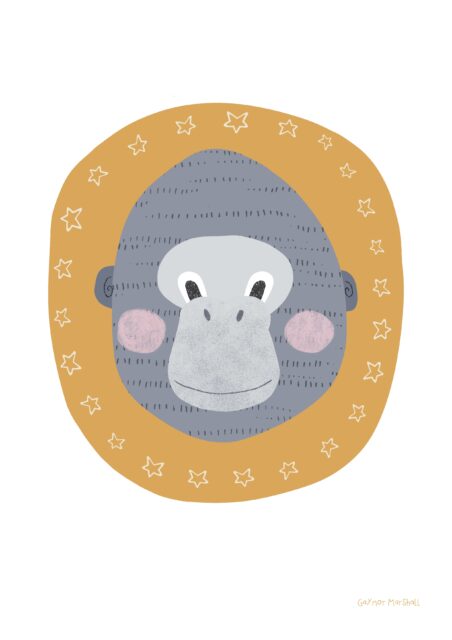
illustrated western lowland gorilla on a mustard background with a ring of hand drawn stars

https://gaynormarshalldesigns.com/the-elephant-majestic-beautiful-and-precious

https://gaynormarshalldesigns.com/who-smells-like-popcorn

Primary Sidebar

Printable Downloads

Search

Join My Substack

Copyright © 2017-2026 Gaynor Marshall

We are using cookies to give you the best experience on our website.

You can find out more about which cookies we are using or switch them off in .

Gaynor Marshall | Sewing and Design
Powered by  GDPR Cookie Compliance
Privacy Overview

This website uses cookies so that we can provide you with the best user experience possible. Cookie information is stored in your browser and performs functions such as recognising you when you return to our website and helping our team to understand which sections of the website you find most interesting and useful.

Strictly Necessary Cookies

Strictly Necessary Cookie should be enabled at all times so that we can save your preferences for cookie settings.

Cookie Policy

More information about our Cookie Policy