• Skip to main content
  • Skip to secondary menu
  • Skip to primary sidebar

Gaynor Marshall | Sewing and Design

Designing Calm, One Stitch at a Time

  • Home
  • Store
  • About
    • Copyright
    • Disclosure Policy
  • Blog
    • The Cottagecore Aesthetic: Understanding What it is and How to Use it
    • Crafting for Wellness
      • Mindful Crafting: Unlock Creativity and Transform Wellbeing
    • Discover the Inventor of the Sewing Machine: A Fascinating History
    • Sewing
      • Spring Sewing Delights: Fresh Projects to Celebrate the Season
      • Sewing Essentials: Setup & Success
        • How to Set Up an Inspiring Sewing Workspace at Home
        • Sewing Tools: My Essential Top Ten
        • Stitch Library – Ultimate Guide
        • Successful Sewing: My 5 Secrets
        • Thread Basics: The Ultimate Beginner’s Guide to Sewing and Embroidery
    • Tutorials
      • Buttons: Make Your Own
      • Creative Ways to Use Machine Embroidery for Stunning Projects
      • Drawstring Bags: Make Your Own
      • Creative Embroidery Templates: Think Outside the Box for Unique Designs
      • Mini Bunting Make Your Own
      • Take Your Sewing to the Next Level
      • Zips
        • Zips, Part 1: Invisible Zip
        • Zips, Part 2: Semi-concealed Zip
        • Zips, Part 3: Concealed Zip
        • Zips, Part 4: Exposed Zip
  • Get In Touch
    • Cookie Policy
    • Privacy Policy
    • Terms & Conditions
Home » fabric

fabric

The Vintage & Retro Revival In Today’s Home Furnishings

April 17, 2025 By Gaynor Marshall

How Classic Textiles Are Shaping Today’s Home Furnishings

As someone who has spent years immersed in the world of sewing, I’ve witnessed trends come and go. But there’s something uniquely enduring about vintage textiles. Right now, we’re seeing a full-blown revival—florals, chintz, mid-century geometrics and toile are reemerging in modern homes with striking confidence. And it’s not just about aesthetics; it’s about creating comfort, character and connection through fabric.

What Defines Vintage & Retro Textiles?

Let’s start with the basics. Vintage textiles typically refer to fabrics produced or popularised before the 1980s. Think rich florals, ornate damasks, pastoral toile or even kitschy kitchen prints from the ’50s and ’60s. Retro, on the other hand, refers to modern fabrics that mimic these older styles.

These prints often carry a sense of nostalgia. There’s an emotional link we form with fabric that reminds us of our grandmother’s drapes or that iconic chair in the family sitting room. That familiarity is what makes vintage patterns so powerful in today’s interiors.

Why They’re Back: Cultural & Design Influences

We’re in an era of reclaiming comfort and personality in our living spaces. As minimalist trends soften and people lean into “slow living,” vintage and retro styles bring a warmth that mass-produced decor often lacks.

Designers are pairing bold 70s florals with clean Scandinavian lines or layering chintz over rustic farmhouse styles. The mix of old and new creates a lived-in, layered effect that feels curated and thoughtful.

Popular Applications in Home Furnishings

Cushions & Throws: A small commitment with high impact. Vintage florals or checkerboard prints can instantly brighten a sofa or bed. Add piping for extra polish.

Curtains & Roman Blinds: Large-scale prints work beautifully on window treatments. Look for linen or barkcloth textures to elevate the effect.

Table Linens: From ruffled table skirts to scalloped placemats, retro-inspired linens can breathe life into a dining space.

Upholstery Projects: Reupholstering a flea market chair with a bold 60s pattern? Yes, please. Use interfacing and backing fabrics to reinforce delicate vintage materials.

Bedding: Patchwork quilts, bed valances and even duvet covers offer perfect opportunities to combine multiple vintage prints for a collected look.

Fabric Sourcing Tips

If you’re lucky, estate sales and charity shops can be goldmines. But many online sellers now specialise in vintage yardage. Be sure to:

  • Check for fibre content and flaws (a burn test can help identify fibres).
  • Pre-wash gently and air dry to preserve the fabric’s integrity.
  • Don’t overlook vintage sheets or curtains—they make excellent sewing material!

If working with true vintage isn’t feasible, many modern fabric companies are reprinting retro designs on new, sturdy cottons and linens.

Sewing Considerations

Working with older fabrics requires a bit of finesse:

  • Pre-wash and iron before cutting.
  • Stabilise thinner fabrics with fusible interfacing.
  • Consider French seams or overlocking for durability.
  • Match patterns carefully, especially with large-scale repeats.

Remember, part of the charm of vintage textiles lies in their imperfections. Embrace the quirks—they’re part of the story.

Mixing Old with New

Balance is key. Use a bold vintage fabric for a statement piece, then pair it with neutral or textured solids to keep the look fresh. A floral cushion on a modern leather chair or a scalloped retro tablecloth in an otherwise minimal dining room—those are the pairings that pop.

Colour cohesion helps too. Pull a palette from your vintage fabric and repeat it throughout the room for a cohesive design.

Project Inspiration

Need a starting point? Try these:

  • Envelope cushion covers with contrast piping
  • Ruffled sink skirts or table skirts
  • Quilted chair pads or floor cushions
  • Reversible placemats with clashing retro prints
  • A patchwork wall hanging from scrap fabrics

Stitching the Past into the Present

Vintage fabrics don’t just tell a story—they invite us to become part of it. In a world dominated by fast fashion and mass production, sewing with retro textiles is an act of artistry and mindfulness. Whether you’re repurposing a floral curtain panel into a set of napkins, or transforming barkcloth into a bespoke lampshade, you’re creating something that celebrates the past while living proudly in the present.

So go ahead. Cut into that vintage yardage. The story is yours to finish.

Creative Embroidery Templates: Think Outside the Box for Unique Designs

January 14, 2018 By Gaynor Marshall

wildlife_friends_finished_projects

I’m sure that like me, you try to get the most out of your creative purchases. We all like added value especially when we work hard for our money. So, when I designed my embroidery templates I was keen to explore other ways to use them. Of course you can use these creative suggestions for any templates that you may already have.

More than just embroidery templates

Alfie, Ethan and Sophie are such cute little characters, I immediately thought they’d look awesome appliqued onto cushions and of course hoop art.

The images can be used as they are but I decided to enlarge them slightly.

all_three_embroidery_templates

The simple shapes of the embroidery templates lend themselves perfectly to the technique of applique and of course they can be further embellished if you wish.

Ethan Whale: easy cushion

ethan_finished_cushion

  • I traced around Ethan onto some Bondaweb and ironed this onto my chosen fabric. For my little panels I used 8″ squares of cotton fabric. You can use any size for your projects though, it’s entirely up to you.
  • I then cut Ethan out and ironed him in place on the white panel.

ethan_template

  • Using some white thread, I machine stitched around the outside of Ethan close to the edge of the fabric. I used the normal foot on the machine and took my time, taking care around his tail. I did this a couple of times. Don’t worry if you wobble a little with your stitching, no one will see.

ethan_close_up_of_tail

  • I used the same fabric on the reverse of the cushion. Simply stitch the front and back panels together, leaving a gap for turning and then stuff with toy stuffing. Hand stitch the seam closed to finish and enjoy! A simple yet effective little, decorative cushion.

ethan_decorative_cushion

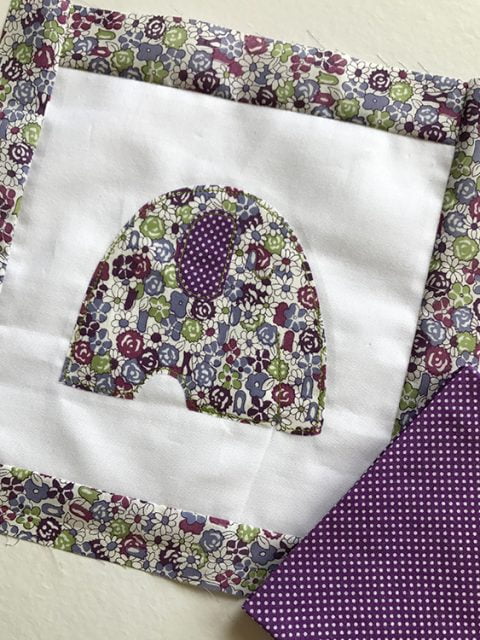
Sophie Elephant: bordered cushion

sophie_finished_cushion

  • As with Ethan, I used Bondaweb to applique Sophie onto the white cotton fabric.

sophie_template

  •  I chose a purple mini polkadot fabric for her ear, and I picked out the green in the fabric to stitch the ear close to the edge of the fabric. I also used this colour to stitch around Sophie.

sophie_close-up_ear

  • To make the border, I chose the same fabric I had used for Sophie, and cut 4 strips that were 1.5″ wide and long enough to border the main panel.

sophie_pinned_border

  • Stitch the border strips on the top and bottom first, and press in place using an iron.
  • Do the same on the remaining two sides and trim away any excess.

sophie_border_attached

  • I chose to use some of the purple mini polkadot fabric for the reverse. Cut to the same size as the front panel and sew together as before.

sophie_finished_cushion

Alfie Giraffe: appliqued hoop art

alfie_hoop_and_thread

This is the simplest project, but I think it’s still as striking and definitely fun.

  • Follow the steps above to applique Alfie onto the cotton panel.

alfie_template

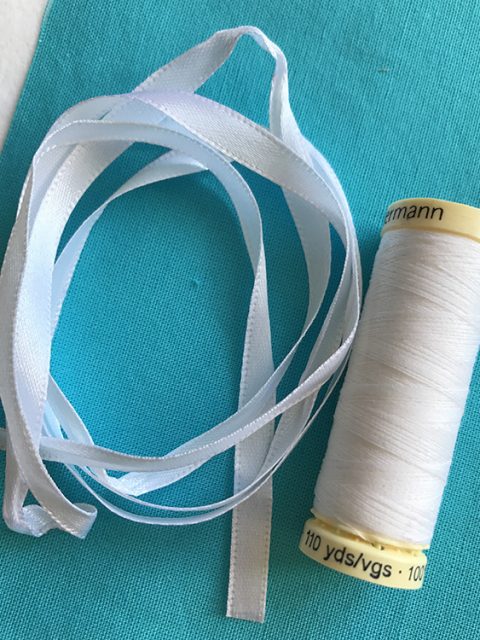
  • This time I used a gorgeous turquoise thread to outline Alfie, using the same method as above.
  • I placed Alfie in a 6″ hoop, and gathered the excess fabric at the back. A quick and easy piece of original art. Bespoke and personal, a unique way to decorate your home.

alfie_close_up_with_thread

Wildlife Friends

wildlife_friends_finished_projects

I hope you like these projects, and if they inspire you to create your own, why not share them on Instagram using #gaynormdesigns, I’d love to see them.

Until next time…

blog_signature

Creative Ways to Use Machine Embroidery for Stunning Projects

November 5, 2017 By Gaynor Marshall

pink_hoop_art_4

Design your own fabric using decorative machine embroidery!

I’m sure you’ll agree, beautiful fabric is one of lifes’ necessities…erm…ok…luxuries; the colour, the texture, the feelings it can evoke, the endless creative possibilities. You’ll also be aware of how expensive good quality fabric can be. I’m not trying to talk myself out of my surface design job, but I want to share a quick and easy way to create gorgeous, unique fabric using only plain fabric and thread.

Decorative Machine Embroidery.

Your sewing machine is a fabulous tool. A very, under-used tool. Most of the time, the only stitch we use is the straight stitch; much needed and very necessary when sewing seams, but not the only one available.

Even if you have an entry level sewing machine, it will have a good handful of utility and decorative machine embroidery stitches. Have a look. If you create a stitch library you will be able to see at a glance the array of stitches available to you.

I have designed a number of projects suitable for using any of the stitches you have on your machine. Use them to create home decor items, either for yourself or to give to a loved one or friend.

 Projects.

1. Pincushion

The first project I want to share is a pincushion. Very simple to put together but very stylish and no one anywhere will have one the same style.

turquoise_pin_cushion_1

  • I wanted to create a 6″ (15cm) finished pincusion. I cut 2 squares of main fabric and two squares of lining measuring 6.5″ x 6.5″ ( 16cm x 16cm approx.). You don’t have to use lining fabric you could use stabiliser, thin wadding or anything you have to hand for the inside.

fabric_pieces

  • Using two contrasting colours makes a bigger impact.
  • For the turquoise side I used a bright pink thread and for the green side I used a turquoise thread. I find the best thing to do is to draw a straight line with an air erasable pen so that your first row of stitches is straight. It doesn’t matter whether you start at the edge of your fabric or the centre, I prefer to start in the centre and then space the rows evenly either side.

stitches_on_machine

  • You may choose to sew a random selection of decorative embroidery stitches, or you could mirror them to create a further interesting design feature.
  • Once both your fabric pieces are complete, place them right sides together and sew them together using a straight stitch, remembering to leave a small gap for turning.

decorative_stitches_right_sides_together

turn_out

neaten_seams

  • When you have turned the pincushion out and you are happy with the corners, stuff it firmly with toy or craft stuffing. The trick when stuffing anything is to use small pieces until it is firm and evenly filled.
  • Hand sew the gap using a ladder stitch.

stuff_pin_cushion

embroidered_turquoise_pincushion

  • I also rotated the fabric pieces, so that on one side the stitches ran top to bottom and on the reverse they are side to side. Another design feature for a totally bespoke pincushion.

2. Scissor Keeper

The instructions for making scissor keepers is almost identical to those for a pincushion. The only difference, apart from size, is you need to add a piece of ribbon or cord before you stitch the two pieces together.

For reference my scissor keepers measure 2″ x 2″ and 3″ x 2.5″ finished sizes (5cm x 5cm & 7.5cm x 6cm approx). Add 1/4″ (1cm) for the seam allowances.

materials_for_scissor_keeper

scissor_keeper_adding_ribbon

  • Carefully tack / baste the ribbon in place before stitching the outer pieces together.

stuff_scissor_keeper

These handy little notions can be made in a variety of sizes for different scissors and can even be used as keyrings.

turquoise_scissor_keeper

scissor_keepers

pink_scissor_keeper

3. Hoop Art.

Use fabric in an embroidery hoop as a modern style of wall art.

These clever little inventions lend themselves perfectly to home decor. Arrange them in groups of varying sizes to add interest to a plain wall.

  • To crate your own hoop art, choose the hoop size you wish to use and stitch your fabric. Make sure the piece of fabric you use is big enough to fit inside the hoop.
  • Trim the fabric piece by using the inner hoop as a template and fix onto the frame.

pink_hoop_art

Display proudly on your wall!

4. Wall Art.

Another idea is to stitch a panel of fabric using decorative machine embroidery stitches and display in a box frame. I created a simple design by using one stitch in the centre of the panel and then I mirrored the outer stitches to form a balanced design.

embroidery_black_frame

embroidery_black_frame_1

embroidery_white_frame_1

Use more than one colour and see the different effects you can achieve. A rainbow of colours would look stunning.

I hope you enjoy creating your own fabric using the decorative machine stitches on your sewing machine. Feel free to share photos of your makes using #gaynormdesigns over on Instagram, I’d love to see them.

Until next time…

Gaynor xx

Buttons: Make Your Own

October 4, 2017 By Gaynor Marshall

handmade_buttons

Bespoke Buttons

Make your own buttons to match or co-ordinate beautifully with either your outfit or your craft or sewing project. This takes your project to the next level as well as being particularly eye-catching.

This is also a great little stash busting project because you only need relatively small amounts of fabric.

In this slideshow I show you just how easy it is to create your own.

Ultimate Stitch Library: Your Go-To Guide for Every Stitch

September 24, 2017 By Gaynor Marshall

stitch_sample

A stitch library is something every sewist should make.

“I finally bought the sewing machine, now what?”

I bet this question resonates with lots of people who’ve bought a sewing machine. You’ve dreamt of the day you can fill your world with things you’ve sewn yourself. The entire new wardrobe of clothes you’ll be able to make, the curtains and cushions…lots and lots of cushions.

You’ve spent weeks, months even years choosing just the right machine; you’ve watched all the shopping channels until you know as much about the technical aspect of all their machines as the presenters.

However, now you actually have the longed for sewing machine, what do you do? Where do you start?

Rainbow_threads_and_fabric

This scenario reminds me of the time, shortly after hubby and I got married; you know back when the world was still in black and white (as my boys thought when they were little!), when we bought our first microwave. I thought it was really exciting, hubby not so much, his mum already had one.

Anyway, we brought this cool, modern gadget home. This was going to save so much time, the gas cooker will just gather dust now, surely. Well, there it sat on the worktop and we stood and admired it, we read the manual, we read the suggested recipes. What though, should we actually cook first? No idea. We re-read the recipe suggestions. No. Nothing was jumping out.

Eventually, we heated something up, beans, I think. The point was, we were at a bit of a loss as to what we should do first. We, had been so caught up in having a microwave that we didn’t really plan beyond buying it, and that’s how many people feel when they open their first sewing machine at home.

Juno_and_my_new_machine

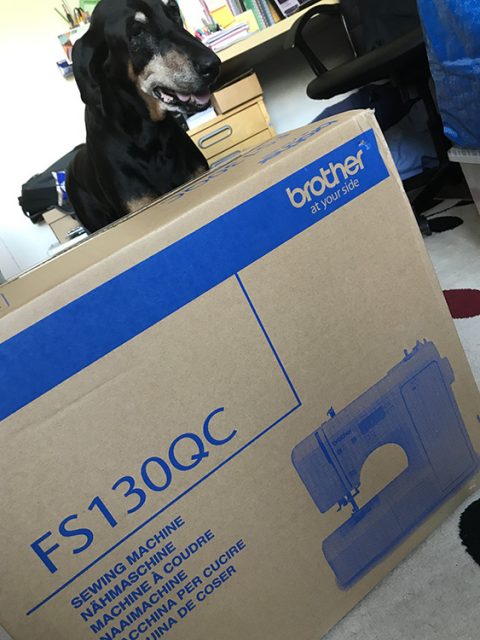
Well, the first thing to do is take it out of the box. It’s okay to sit and admire it for a while; you can make a cuppa, take out the manual and read it.

Familiarise yourself with the basics of the set-up and following the instructions in the manual, thread your machine. Practise a few rows of straight stitching on a scrap piece of fabric to check everything is working correctly.

At this point, unless you have a definite plan of action it would be so easy to put everything away. You know how it all works, you’ve had a little sew. Well, I suggest you do this instead…

You will have noticed that in the manual and probably on the machine itself there is a library of stitches. This is a very handy reference guide for the number and type of stitches that your particular sewing machine can produce. However, as these are printed images, they can sometimes appear slightly different when you stitch them. One great way to see what the stitches on your machine look like in real life is to stitch them; create your own stitch library.

stitch_sample

It’s much easier to see all of the stitches this way, you can alter the stitch length and width to compare to the default stitch and you’ll have this for future reference.

Cut out two pieces of fabric; I used my long ruler as a measure and I chose the full width of a piece of linen and a piece of spare lining fabric.It’s much easier to see all of the stitches this way, you can alter the stitch length and width to compare to the default stitch and you’ll have this for future reference.

long_ruler_scissors_and_pen

It doesn’t matter if you have a basic machine with a handful of stitches or a top of the range model with hundreds, doing this exercise will enable you to create a very useful chart, get to know your machine and practise your sewing skills, all at the same time.

stitch_library_samples

The main thing to remember is to have fun! Making a stitch library will boost your confidence and when it’s finished, you’ll have something pretty to look at too!

Until next time…

blog_signature

Primary Sidebar

Printable Downloads

Search

Join My Substack

Copyright © 2017-2026 Gaynor Marshall

We are using cookies to give you the best experience on our website.

You can find out more about which cookies we are using or switch them off in .

Gaynor Marshall | Sewing and Design
Powered by  GDPR Cookie Compliance
Privacy Overview

This website uses cookies so that we can provide you with the best user experience possible. Cookie information is stored in your browser and performs functions such as recognising you when you return to our website and helping our team to understand which sections of the website you find most interesting and useful.

Strictly Necessary Cookies

Strictly Necessary Cookie should be enabled at all times so that we can save your preferences for cookie settings.

Cookie Policy

More information about our Cookie Policy